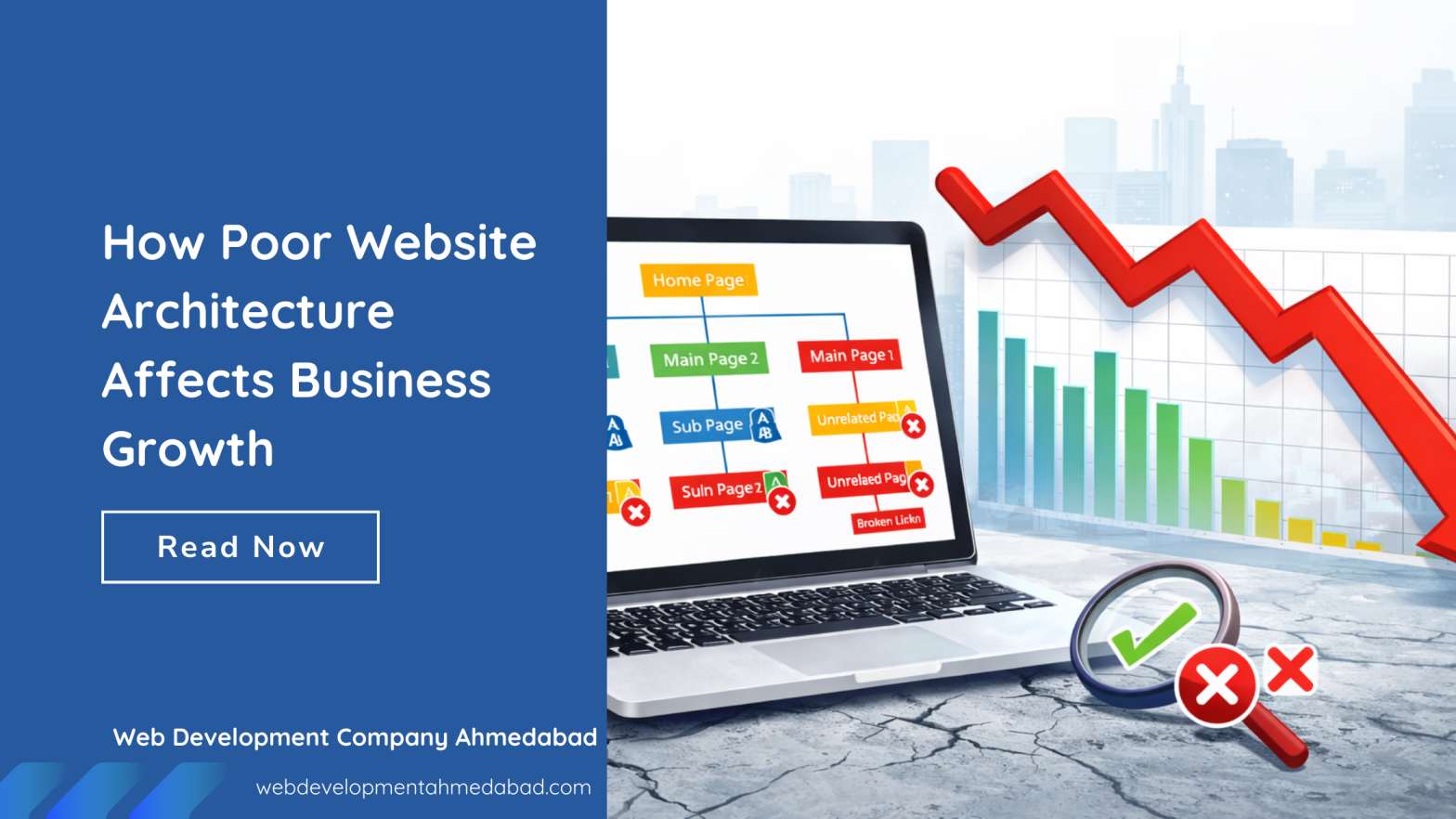
How Poor Website Architecture Impacts Business Growth
Many businesses reach a point where their website feels busy but ineffective. Traffic reports look acceptable, content keeps increasing, and yet real growth stays slow. Leads do not scale, enquiries feel inconsistent, and users leave without clarity. This situation feels confusing because nothing appears broken on the surface.
The reason is often structural. Website architecture controls how pages relate, how users move, and how search engines interpret importance. When this structure lacks clarity, effort gets wasted quietly. Over time, the website stops supporting growth and starts slowing it down.
Key Takeaways:
- Website architecture shapes user flow and search visibility together
- Poor structure blocks growth without obvious technical errors
- Traffic alone cannot compensate for weak page relationships
- A clear structure helps users decide and helps search engines understand
What Is Poor Website Architecture And Why Does It Happen
Website architecture refers to how pages are arranged, grouped, and linked across a site. It decides which pages feel central and which feel secondary. When this system lacks logic, the website becomes harder to navigate and harder to interpret.
Poor architecture usually develops gradually. It forms when websites grow reactively instead of strategically. Because changes happen in small steps, the damage is not noticed until growth starts slowing.
In fact, these patterns are commonly seen during audits and reviews shared by our team at Web Development Company Ahmedabad, where most growth issues trace back to structural decisions made without long-term clarity.
What Website Architecture Means In Simple Terms
In simple terms, website architecture is the internal map of a website. It defines how someone moves from the homepage to services, from services to details, and from content to action. A clear structure feels invisible because movement feels natural.
However, when this map is unclear, users hesitate. They click randomly, retrace steps, and lose direction. At the same time, search engines struggle to understand which pages matter most.
What Poor Website Architecture Looks Like In Real Websites
In real-world websites, poor architecture often shows up as cluttered navigation and deep page paths. Important pages may be buried under multiple layers. Similar topics might be spread across unrelated sections.
As a result, the website feels disjointed. Even strong content loses impact because nothing supports it properly.
Why Businesses Create Structure Without Planning
Most businesses build websites over time. First, a basic version goes live. Later, new services, blogs, and landing pages are added. Each addition solves an immediate need.
Because no one revisits the overall structure, connections weaken. Over time, the website grows wider instead of clearer, and confusion becomes part of the system.
How Poor Website Architecture Affects Users
Users arrive on a website with limited patience. They expect clarity, direction, and reassurance. When structure interferes, frustration builds quickly, even if users cannot explain why.
Poor architecture increases mental effort. That effort reduces trust and engagement before users even read the content fully.
Why Users Struggle To Find Key Information
When pages are not grouped logically, users cannot predict where information lives. They click menus, open pages, and go back repeatedly. Each step increases effort.
Because alternatives are easy to find online, users often leave instead of continuing the search.
How Confusing Navigation Increases Frustration
Navigation is meant to guide silently. When menus are crowded or labels feel vague, users slow down. They stop trusting the structure. This hesitation breaks the flow. Even interested users begin to doubt whether the website understands their needs.
Why Users Leave Without Taking Action
Action requires confidence. When users feel lost, they hesitate to fill out the forms or click buttons. Calls to action lose meaning without clear context. As a result, visits happen, but decisions do not.
How Poor Website Architecture Affects Search Engines
Search engines rely heavily on structure. They do not see design or intent. Instead, they analyze links, hierarchy, and page relationships. Weak architecture makes this analysis unreliable, which directly affects visibility.
How Search Engines Read And Understand Site Structure
Search engines follow internal links to discover pages. They observe how often pages are linked and where those links come from.
When structure is clear, search engines understand the importance easily. When the structure is weak, signals become inconsistent.
Why Poor Internal Linking Weakens Page Importance
Internal links distribute relevance. When important pages lack internal support, they appear less valuable. Meanwhile, minor pages may receive attention unintentionally. This imbalance weakens overall SEO strength.
How Crawl And Indexing Issues Begin
Poor architecture creates deep pages and orphan pages. Search engines reach these pages less often or skip them entirely. As a result, content exists but performs poorly.
How Poor Website Architecture Blocks Business Growth
- Business growth depends on flow: Users must move from awareness to understanding to action. Website structure controls this journey. When structure fails, growth slows quietly, without obvious technical errors.
- Traffic Fails To Convert Into Leads: Traffic without direction does not convert. Users land on pages but lack guidance on what comes next. So analytics look healthy, but results remain weak.
- Trust Drops When Structure Feels Messy: Clarity signals professionalism. When pages feel scattered, users sense uncertainty. This affects credibility. Even reliable businesses appear less trustworthy when the structure feels chaotic.
- Sales Funnels Break Silently: Funnels depend on sequence. Poor architecture disrupts that sequence. Users enter but do not progress. The funnel exists conceptually but fails operationally.
Why Poor Website Architecture Becomes a Long-Term Problem
Website structure problems rarely appear all at once. They grow slowly. Each new page or update adds a little more pressure. When the foundation is not clear, the website starts to feel heavy and confusing. That is why many businesses realize the issue only after growth begins to slow.
- Small structure mistakes grow over time: A page is added in the wrong place, then another page follows. Gradually, navigation becomes confusing, and pages lose their connection.
- Fixing architecture later becomes more expensive: Late fixes often need redirects, relinking, and content reshuffling. During this time, performance can become unstable.
- Design changes alone do not solve the problem: A fresh design may look better, but if the structure stays the same, users still feel lost.
What Improves Business Growth by Fixing Architecture
Fixing website architecture is mostly about making things simpler. When pages are well connected and logically placed, the website starts working more smoothly for everyone.
- Clear hierarchy guides users naturally: Users understand where they are and what comes next, so hesitation reduces.
- Strong internal linking supports important pages: Pages help each other, and search engines get clearer signals.
- Simple structure makes decisions easier: Less confusion builds more trust, which leads to better conversions.
Final Answer: How Poor Website Architecture Affects Business Growth
Poor website architecture affects business growth because it removes clarity from the entire experience. Users struggle to move with confidence, search engines struggle to understand importance, and decision paths break silently. As a result, traffic fails to turn into trust, and trust fails to turn into action.
This is also why many businesses eventually realize that choosing the right structure early matters just as much as design or content, a reliable website development company in Ahmedabad usually focuses on from the very beginning.
Because when structure improves, growth feels smoother. Users move naturally, search engines interpret signals clearly, and the website finally supports business goals. In short, growth does not fail due to lack of effort. It fails when the structure does not guide that effort properly.